





What if I hadn’t picked this YSS program?
What if I hadn’t chosen to pursue the pre-med track?
What if I had opted to attend a university closer to home?
What if we spent the next six weeks in Johannesburg instead?
What if I hadn’t eaten that airport sushi that my stomach is now severely regretting?
These are some of the questions that have crossed my mind in the first week of this program. Not because I’ve been yearning to get out of here or regretting my decisions—no, far from it. These first few days in Cape Town have been some of my most memorable experiences this summer. It just scratches an itch to consider what I would be doing if not this. Maybe stuck in a lab on campus? Perhaps working back home? Probably not going on sunset runs along the southern Atlantic coast and having dinner with ANC freedom fighters. Reading my peers’ blog posts, it seems like the sheer breadth of experiences we’ve encountered in the past seven days has gotten us all in a bit of an existential mood. As young people grappling with the possible futures that await us, our lives in the here and now occupy a strange position that comes with both immense privilege and opportunity.
Funnily enough, our introduction to global health has partly involved this kind of “what-if” thinking. This has come in the form of the theme for our first week of classes: epidemiological causation. Discerning cause and effect relationships is of vital importance in public health, whether it is investigating the link between exposure to a new virus and hospitalization rates, or the impact of a diagnostic procedure on mortality. However, the most salient causes of a phenomenon are usually not obvious. This is where “counterfactual thinking”—a helpful framework for assessing the plausibility of cause-and-effect relationships—comes in. Essentially, you imagine an alternative timeline where the cause you are considering did not take place, or did not take place at exactly the same time. The degree to which the effect is different in this alternative timeline is an indicator of the strength of the causal relationship in question.
Jonathan introduced this concept to us in class with the following example. Person A drops a brick on Person B’s head, and Person B loses consciousness immediately afterwards. Can we say that the brick caused B to lose consciousness? What if B had a pre-existing medical condition that leads him to spontaneously faint? Well, think through the counterfactual. In a universe where A did not drop the brick on B’s head, B probably wouldn’t have lost consciousness then and there, even if he had a pre-existing condition. Therefore, we can be much more confident assigning the brick to be the primary cause of the fainting, rather than any pre-existing condition. Morbid, yes, but this example also gestures towards the life-and-death stakes of applying counterfactual reasoning in a public health context.
The point is, thinking about alternative timelines or worlds can tell us quite a bit about our own. On the flipside, our biases and the information available to us in our current moment also shape whatever imagined world we create. After all, the only data we have access to comes from imperfect observations of our current world. Epidemiological reasoning aside though, I think counterfactual thinking is a powerful metaphor for how our hopes, aspirations, the “what ifs” that go through our mind, say a lot about the situation we find ourselves in. Maybe this is why for many cultures around the world, dreams are seen as omens of the future, or windows into a person’s inner psyche. It seems that we’ve always understood that the imagination can at times offer a more truthful view of the underlying forces at play in our reality.
Yet this week I’ve been struck by moments where the relationship between the two doesn’t seem so straightforward. One such moment was during our tour of the District 6 Museum. Our tour guide was a woman (I wish I had asked for her name) who grew up in the formerly multiracial district and witnessed its apartheid-sanctioned destruction in her teens. Now a grandmother of nine, she explained to us matter-of-factly the difficult situation facing youth in South Africa today—how many of her grandchildren were trying to move abroad because of the lack of job prospects and the stalling domestic economy. “We will never be able to move back to District 6,” she stated. It was sobering. Indeed, as the wealth gap grows wider in this country, it is difficult to see how the descendants of former District 6 residents, largely impoverished, will be able to afford the luxury skyrises that are now being built where their former homes once stood.
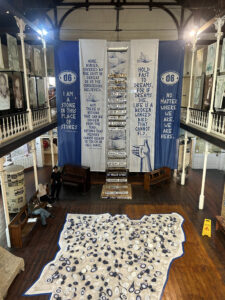
However, what struck me most about this woman’s story were her final remarks at the end of our tour. “I am happy,” she said. “I had a good mother. I take good care of my grandchildren. We are strong people and I am content with the life I have led.” Like everything else she had said on our tour, it was genuine. Here was a woman who had grown up under one of the most severe forms of ideological totalitarianism in the world, who had her world pulled out from under her feet as she was coming into adulthood, and who continued to face precarity on a daily basis. I can’t fathom all the ways she must have imagined her life going differently over the years. Yet, despite all that, it seemed like rather than letting her circumstances drive her into despair, she had found a kind of defiance through a simple everyday attitude of gratitude. Lucky, a political dissident and ex-prisoner of Robben Island who led our tour of the prison, said something that held a similar resonance: “These tours are my therapy. They are my counseling.” Having been pinned into horrific circumstances by forces much larger than himself, he found a way to reclaim his relationship to his past and share it with others on his own terms. Both the grandmother and Lucky ultimately challenged the view that there is a straightforward cause-and-effect relationship between one’s situation and the kind of world they are able to imagine for themselves.
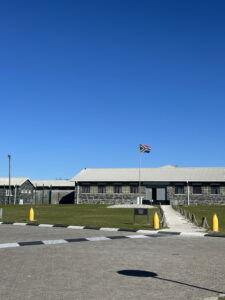
As I’ve been learning more about Cape Town and South Africa, I’m reminded of the contingency of history. This place makes it clear that nothing is inevitable. Not the racial logic of apartheid, not the political-economic crises of the present, not the persistent hope and striving of individuals that continue to come together despite the odds. All of these occurrences were the product of choices that could have been otherwise. Here my awkward metaphor reaches its limits. It is one thing to think “what if” in an epidemiological context and another to apply it to existential questions like what it means to belong to a place or a inhabit an identity. Yes, counterfactual thinking allows us to imagine alternative, better worlds, but it is ultimately in service of the assumption that there is an underlying causal determinism in the universe. While I strongly agree that from a scientific perspective, we must reason in terms of causal structures, the world of social meanings is not so rigid. As our tour guides at the District 6 Museum and Robben Island demonstrate through their stories, people will always be the confounding variable, finding ways to resist the boxes and determinations that are thrust upon them. Nevertheless, their resilience and adaptability is not an excuse to turn a blind eye to the suffering and injustice around us. Quite the contrary—we owe a responsibility to their imagined better futures to act in any way we can.
At the end of the day, what I think is most powerful about counterfactual thinking (albeit with the very little I have learned about it so far) is that it helps us make practical decisions in face of unknowns instead of chasing the impossible goal of eliminating uncertainty. I came into this program hoping it would teach me more about global health, storytelling, South Africa, and, on some level, myself. And while I am making new discoveries about all of those things, I’m also starting to understand that the next weeks will more fundamentally be about learning what it takes to make better choices in the absence of right ones. While I don’t know where this summer will lie in the inscrutable web of cause and effect, I’m ok with sitting in that uncertainty. I know that we can make a difference in this timeline.